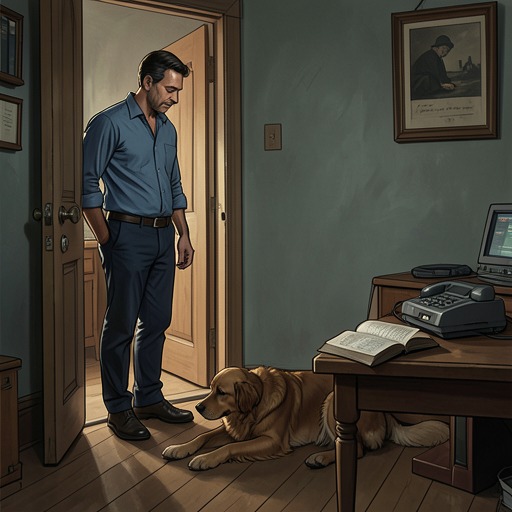
Christopher leaves home after Father’s confession
The Curious Incident of the Dog in the Night-TimeChristopher leaves home after Father’s confession because the murder of Wellington overturns the trust on which his safety at home depended. The departure begins not as a planned journey but as an urgent attempt to get away unseen; after testing and abandoning safer-seeming options, Christopher decides to travel from Swindon to London and live with Mother.
The confession and the decision to flee
Father’s admission changes what Christopher believes about their home. Although Father had asked him to trust him, Christopher reasons that a person who has lied about something so important could also kill him. He therefore regards staying in the house as dangerous, not merely uncomfortable, and plans to leave only when Father will not see him.
The timing is deliberate. At 11:16 p.m. Christopher is still waiting, and he does not act until he has heard Father go to sleep. He remains quiet and watches for a chance to move without waking him. Fear governs the immediate plan, while Christopher’s reasoning gives it a sequence: wait, leave without attracting attention, and find somewhere else to live.
A quiet exit with Toby
Once Father is asleep, Christopher gathers both coats and his scarf from the hooks by the front door, putting them on because it is night and cold. He goes upstairs for Toby’s cage. When Toby scratches inside it, Christopher uses one of the coats to muffle the sound, then carries the cage downstairs. He leaves the other coat over it because he does not want Toby to get cold and die.
Christopher also takes his special food box. He chooses the back door, unlocks it, and holds the handle down as he shuts it so the click will not be too loud. Instead of leaving the garden at once, he moves to the shed at its far end. He judges the shed itself too obvious a hiding place because Father might search there, and squeezes into the narrow gap between the shed wall and fence, behind the large rainwater tub. The hidden position gives him some sense of safety while he waits.
From hiding to a destination
Christopher stays still for 27 minutes. When he hears Father start the van and then drive away, he recognizes the sound and concludes that it is safe to come out. His careful identification of the vehicle contrasts with the uncertainty of what to do next: knowing that Father has left does not solve the larger problem of where Christopher can live.
His first proposed destination is Mrs. Shears’s house. Christopher knows her, has stayed there before during a power cut, and does not consider her a stranger. He hopes that telling her who killed Wellington will show that he is a friend and explain why he cannot live with Father. But he recognizes that none of the possibilities he considers feels safe. He approaches the decision as he would a mathematics problem, mentally crossing out options he regards as impossible until one remains.
London, Mother, and the cost of escape
The remaining choice is to go to London and live with Mother. Christopher makes the plan concrete through what he knows about trains: consult a timetable, go to the station, buy a ticket, check the departure board, find the correct platform, and board. He identifies Swindon station as his starting point, connecting the journey to a detail he knows from Sherlock Holmes and Dr. Watson’s route in The Boscombe Valley Mystery.
The choice carries an emotional cost as well as a practical one. Christopher thinks of London as home now, but the distance—about 100 miles—makes the separation tangible. A rusty, circular metal lid beside the passage near Mrs. Shears’s house reminds him of a planet, its rust marked like countries, continents, and islands. The image leads him to consider the distance of space and the astronaut he had hoped to become; realizing that he cannot become one makes him sad. The passage therefore sets a concrete escape route beside a larger loss: getting away from Father means moving toward Mother, while the journey also forces Christopher to confront the distance between his present circumstances and his earlier dream.
Narrative significance
The departure is a turning point from investigation to flight. Christopher’s discovery that Father killed Wellington does not remain an abstract answer to a mystery: it changes his assessment of the person and house he had depended on, and prompts him to protect himself and Toby. At each stage he relies on rules, observation, and elimination—waiting for sleep, recognizing the van, choosing a hiding place, and narrowing possible destinations—because those procedures make a frightening decision manageable.
The episode also establishes the limits of that control. Christopher can plan the train journey in exact steps, but he cannot make any available choice feel safe, nor can calculation remove the sadness attached to leaving. His decision to go to London is both an act of self-preservation and a movement toward the mother he understands as his home, setting the next stage of his journey in motion.